
How to Journal Trades Around High-Impact Economic Events
- HybridTrader Editorial
- Updated

Scheduled economic events, central bank rate decisions, inflation reports, employment figures, create sudden volatility that can catch traders off guard. Rather than predict where markets will move, traders can use journaling to bring structure to these high-stress moments by recording pre-event conditions, formulating potential scenarios, and documenting their actual response. This transforms reactive chaos into material for deliberate review, revealing patterns in both market behavior and personal decision-making without relying on forecasts.
This article shows how to record and analyze trades around scheduled economic announcements. What to capture before an event, how to document the reaction, and how to extract learning from the comparison between preparation and outcome.
Quick answer: documenting trades around economic news
Economic events are scheduled data releases, GDP, inflation figures, interest rate decisions, employment statistics, that typically move financial markets. Trade journaling around these events means recording prevailing conditions before the release, defining possible market reactions in advance (not predicting a single outcome), documenting any trades executed, capturing the actual event outcome and immediate market response, then reviewing the session to identify patterns and behavioral lessons.
The core benefit isn't improved forecasting accuracy. It's improved self-awareness.
A comprehensive journal can reveal how a trader responds to uncertainty, whether pre-event planning actually shapes execution, and whether certain types of market reactions repeat across multiple events.
What the event measures
Economic events report statistics collected by government agencies or central banks: inflation, employment, growth, consumer spending, monetary policy decisions. The data are released on a predetermined schedule and time, often announced months or quarters in advance.
Examples of high-impact economic events include:
- Central bank interest rate decisions and accompanying statements (Federal Reserve policy meetings, European Central Bank decisions)
- Employment reports (non-farm payroll figures in the United States)
- Inflation data (Consumer Price Index, Producer Price Index)
- Gross Domestic Product reports
- Consumer and business sentiment surveys
These events are tracked in economic calendars, which display the scheduled release date and time, the issuing country or region, previous figures, consensus forecasts, and later the actual released data. The calendar serves as the primary reference for identifying which upcoming events may be relevant to the asset classes and markets a trader monitors.
Why traders monitor it
Traders monitor scheduled economic events because the data can shift market expectations about future economic conditions, inflation, and central bank policy. When actual figures differ significantly from consensus forecasts, or when forward guidance accompanying a policy decision surprises markets, price volatility often increases sharply.
The direction and magnitude of a market move in response to an event aren't predetermined, though. Markets may price in expectations before the release, leading to a muted reaction when the data arrives. Or they may react counter-intuitively if the data is interpreted within a different macroeconomic narrative than traders had anticipated.
This inherent unpredictability is why scenario planning, rather than directional prediction, is the appropriate framework for traders preparing to monitor or trade around these events.
By documenting pre-event conditions and multiple possible post-event scenarios, traders create a foundation for review. After the event, comparing what actually happened against the scenarios prepared in advance reveals whether the market behaved in line with one of the anticipated possibilities, acted unexpectedly, or showed a delayed reaction. This comparison becomes the basis for identifying recurring patterns and refining future preparation.
Possible scenarios, not predictions
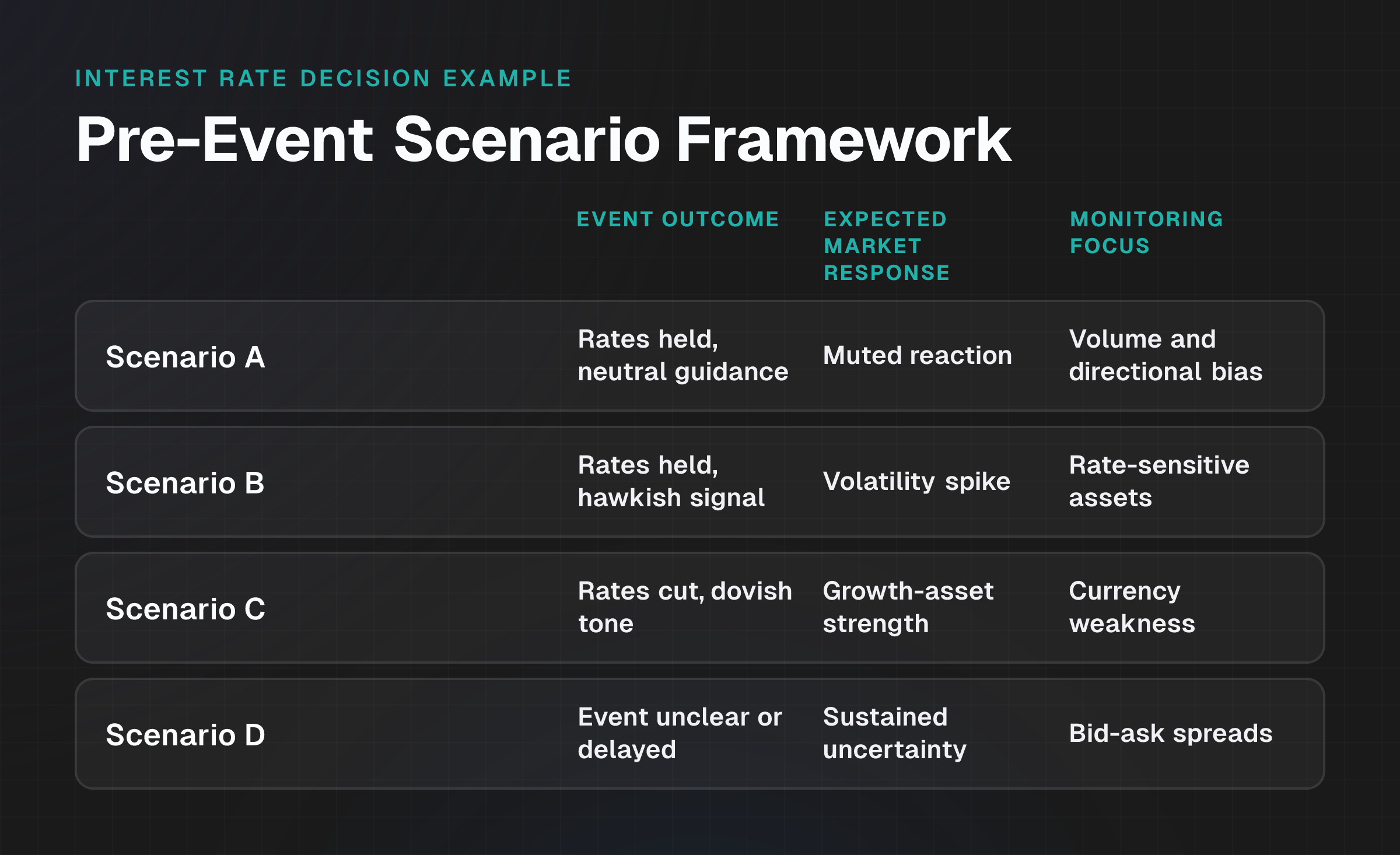
Scenario planning means outlining multiple potential market reactions to different economic outcomes before the event is released. Distinct from predicting a single direction or magnitude of move.
A trader monitoring an interest rate decision might prepare scenarios such as:
- Scenario A: Rates held steady, forward guidance neutral → expect a muted reaction, focus on volume and directional bias in price action.
- Scenario B: Rates held but the central bank signals future tightening → watch for an initial spike in volatility; markets may sell off assets sensitive to rate expectations.
- Scenario C: Rates cut, statement dovish → anticipate potential strength in growth-sensitive assets and weakness in currencies perceived as higher-yielding or defensive.
- Scenario D: Event delayed, postponed, or communicated unclearly → prepare for sustained uncertainty and wider bid-ask spreads.
Each scenario includes an if-then structure: if the economic data or policy announcement takes this form, then these are the possible market reactions to monitor. The trader doesn't assign a probability to which scenario will occur; instead, they prepare a response framework for each one.
The advantage? A proactive, uncertainty-aware mindset. Rather than waiting for the event to occur and then reacting emotionally to unexpected market moves, the trader has already considered multiple possibilities and can reference them during and immediately after the release. This doesn't guarantee profitable trades, but it reduces the likelihood of purely reactive, emotionally driven decisions made under high stress.
Markets commonly affected
Economic events in one region typically create ripple effects across correlated asset classes and geographies:
- Currency markets are often the most immediate responders to economic data and central bank decisions, as the events directly signal changes in interest rate expectations and economic growth prospects.
- Equity indices typically respond to economic data that reflects growth expectations and corporate earnings prospects; central bank policy announcements can also trigger sharp moves as they signal changes in discount rates and borrowing costs.
- Bond markets respond strongly to inflation data and interest rate decisions, as these directly affect yields and price direction.
- Commodity prices, particularly those denominated in a specific currency (oil in US dollars) or tied to economic demand (industrial metals), can shift with economic data releases and currency moves.
- Implied volatility across multiple asset classes typically spikes before and during high-impact economic announcements, widening bid-ask spreads and increasing execution uncertainty.
A trader monitoring EUR/USD currency pairs should consider not only the economic events scheduled for the eurozone and the United States separately, but also how data from one region historically correlates with moves in the other. A stronger-than-expected US employment report could weaken the euro if it strengthens expectations for US interest rate support, even if no eurozone event is scheduled for the same day.
What to record in a journal
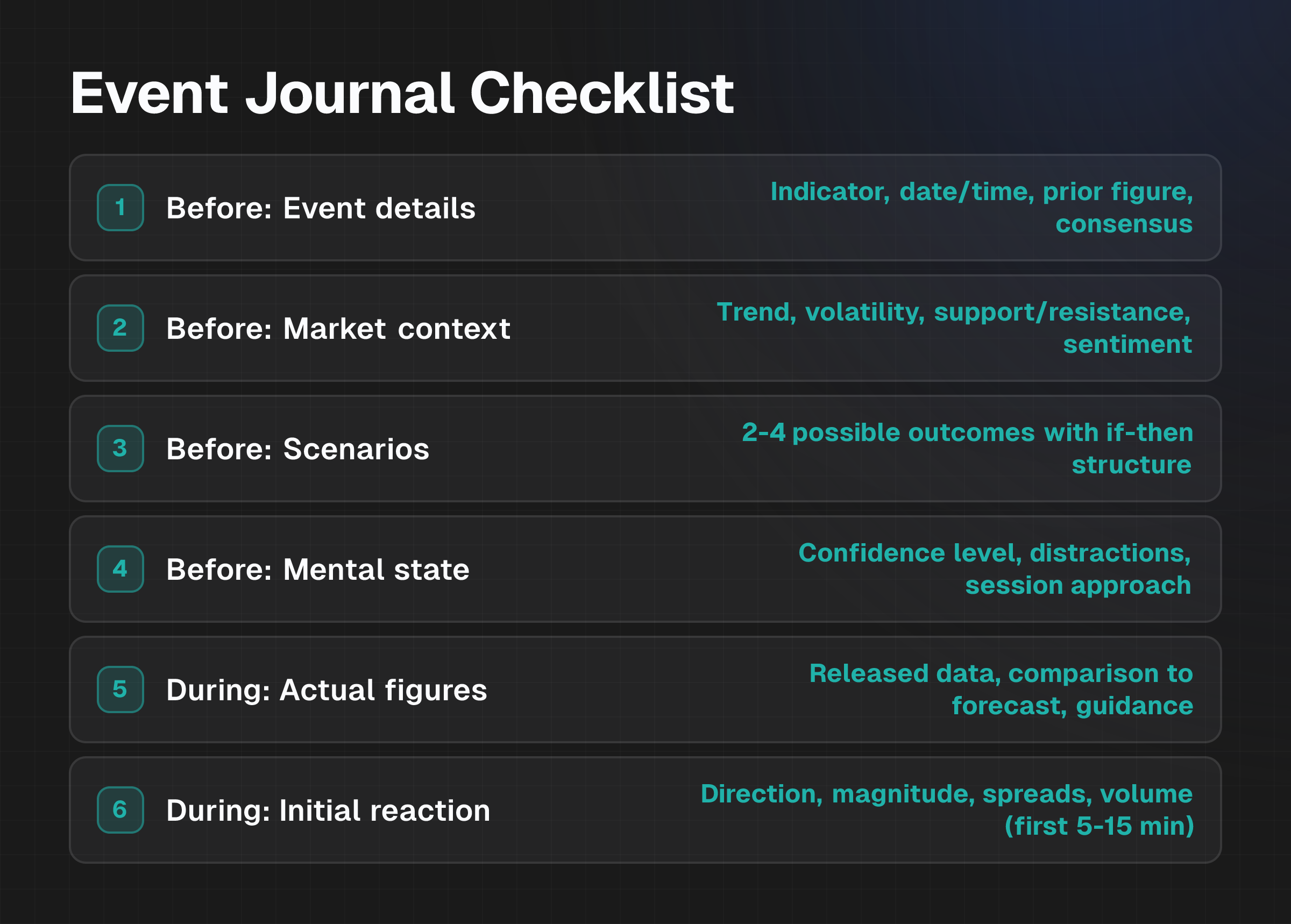
Effective journaling around economic events captures information before, during, and after the release, organized to support later review.
Before the event
- Event details: The specific economic indicator (CPI, ECB decision), the scheduled release date and time (and time zone), the issuing agency or central bank, and the prior figure and consensus forecast if available.
- Pre-event market context: The prevailing trend in the relevant asset or market, recent volatility levels, significant support and resistance areas, any relevant news or market sentiment indicators (positioning in options, recent headlines, implied volatility levels).
- Scenarios prepared: The 2-4 most likely or material market outcomes and how the trader expects each to appear in price action ("If CPI significantly exceeds forecast, watch for immediate dollar strength and a spike in volatility").
- Pre-event emotional and mental state: Confidence level, any external pressures or distractions, and the trader's overall approach to the session ("Planning to observe only; not entering a trade unless a clear setup forms").
During and immediately after the event
- Actual economic figures: The released data, how they compare to the prior figure and consensus forecast, and any relevant commentary or forward guidance from officials.
- Initial market reaction (first 5-15 minutes): The direction and magnitude of the initial move, any whipsaw action, changes in bid-ask spreads, volume spikes.
- Trade execution (if any): Exact entry price and time, position size, stop-loss and take-profit levels, and the specific trade rationale tied to the economic event and the scenarios prepared.
- Emotional state during execution: Confidence, hesitation, FOMO, or any deviations from the pre-planned approach.
After the event (medium and longer-term observations)
- Sustained market reaction (1-4 hours post-event): Whether the initial move persisted, reversed, or evolved into a different pattern. Whether volatility remained elevated or contracted.
- End-of-day and next-day context: How the market closed relative to the pre-event level, any follow-on news or commentary, and how the asset is trading the following session.
- Trade outcome (if applicable): Exit price and time, profit/loss, whether the stop or target was hit, and any manual closing decisions made.
A worked example might read:
Event: ECB Interest Rate Decision, 14 March, 14:00 CET. Prior rate: 4.25%, consensus forecast: rates held. Pre-event context: EURUSD at 1.0850, uptrend over prior week, volatility moderate. Scenario A: Rates held, hawkish tone = EUR strength expected. Scenario B: Rates held, dovish pivot = EUR weakness expected. Entry: Sold EURUSD @ 1.0850, 2 standard lots, stop @ 1.0900, target @ 1.0750. Rationale: Expected dovish tone given recent weak inflation data. Actual outcome: Rates held 4.25%, but statement signaled future tightening more than expected. Market reaction: Initial EUR strength spike, stopped out @ 1.0900 for small loss. Review: The CPI interpretation was sound; the forward guidance shift wasn't anticipated. Future sessions should weight central bank statement language more heavily than preliminary rate expectations alone.
How to review the session afterwards
Post-event review compares what was prepared against what actually occurred, then examines the trader's execution and emotional decisions.
Comparison phase
Did the market match a prepared scenario? Review the actual event outcome and immediate market response against the 2-4 scenarios documented before the release. Did the market behave as one of them anticipated, or did it move in an unexpected way?
What was different? If the market deviated from all prepared scenarios, describe what was different ("The rate decision was neutral, but the accompanying statement contained hawkish language that wasn't anticipated," or "Initial move was as expected, but it reversed sharply after 30 minutes").
Was there a delay? Some events trigger a delayed reaction; market context can shift hours or days after the initial release. Record whether the post-event move unfolded as expected or took longer to develop.
Trade review (if applicable)
- Was the trade aligned with the plan? Did the entry follow the pre-event scenario and rationale, or was it a deviation?
- How did risk management perform? Were the stop-loss and take-profit levels hit as anticipated, or did the volatility and spread environment differ from expectations?
- Emotional alignment: Did emotions drive the trade, or was execution disciplined? Did the trader deviate from the plan under stress?
- Outcome vs. process: Record both the profit/loss and whether the trade followed sound reasoning. A losing trade can result from sound analysis, and a winning trade can result from poor decision-making.
Pattern identification
Recurring observations: Review multiple sessions across similar event types ("Over the past six FOMC meetings, stops were widened under stress despite pre-set risk parameters"). Identify whether certain types of events, or certain emotional states, correlate with specific trading mistakes or successes.
Behavioral patterns: Does a trader tend to chase moves after the initial spike? Widen stops under emotional pressure? Hold winners too long and cut losers too quickly, or vice versa?
A crucial distinction: the journal can show that a pattern appeared in recorded trades; it cannot establish with certainty why it occurred. A repeated association between a certain event type and a particular market reaction is evidence worth reviewing, not proof of causation. Similarly, a repeated correlation between a certain emotional state and a particular trading error is a signal to investigate further, not a confirmed cause.
Sources, timing and uncertainty
Economic data release times are typically set months in advance and published on official calendars maintained by statistical agencies and central banks. Examples include:
- Central bank decisions and statements: Announced on central bank websites (European Central Bank, Bank of England) with scheduled times and dates.
- Employment and inflation data: Published by national statistical offices (US Bureau of Labor Statistics data on employment and inflation).
- Economic calendars: Aggregated on financial data platforms, news sites, and brokerage calendars that list upcoming events, prior figures, and consensus forecasts.
Timing precision
Release times are typically scheduled to the exact minute (13:30 UTC for US employment data). Disruptions can occur, though:
- Delayed or rescheduled releases: Technical issues, political events, or other circumstances can postpone an event, sometimes with short notice. The calendar should be checked the morning of a scheduled release.
- Data revisions: Initial releases are often preliminary and subject to revision in subsequent months. A trader journaling a reaction to an economic number should note whether the data are preliminary or final.
- Statement timing: Central bank policy decisions and statements are often released simultaneously, but sometimes statements are released minutes or hours after the decision, creating a period of uncertainty about the central bank's forward guidance.
Uncertainty and unknowns
Market pricing: Markets price in expectations before an event is released. If consensus forecasts are widely known and largely priced in, the actual data release may trigger a muted reaction even if the figures are strong or weak. This timing difference can't be predicted in advance; it's discovered through observation and review.
Interpretation shifts: The same economic data can be interpreted differently depending on the broader macroeconomic narrative. A strong employment report might be positive for equities in one interest rate environment but negative if markets fear it will prompt more aggressive central bank tightening.
Spillover effects: An event in one market or region can trigger unexpected correlations in others. A trader can't reliably forecast all possible spillover effects in advance.
For these reasons, scenario planning and post-event review are more reliable frameworks than attempting to predict a single market direction. The journal documents what could happen and what actually did happen, creating a factual record for review rather than a forecast record that will inevitably contain errors.
Next step
Begin by identifying one or two high-impact economic events scheduled for the coming week or month that affect the markets or assets a trader is actively monitoring. Before each event, write down the current market context (trend, volatility, sentiment) and prepare 2-4 scenarios for how the market might react to different outcomes. Record the actual event data and the immediate market response.
Then, within a day or two, review the session: compare the actual outcome against the prepared scenarios, examine any trades executed, and identify what was learned about decision-making and market patterns.
The goal isn't to improve profitability overnight, but to build a deliberate practice of observing, planning, executing, and reviewing, a cycle that sharpens both market awareness and self-awareness over time. This process is particularly valuable when applied to reviewing your trading decisions with real data and identifying recurring patterns like revenge trading, both areas where structured journaling reveals insights that reactive trading obscures.