
AI Trading Dashboard: Build a Repeatable Pre-Market Routine
- HybridTrader Editorial
An active trader can use HybridTrader's dashboard, Macro Desk and economic calendar to build a consistent pre-market routine that captures economic events, market bias, and a documented working interpretation, then revisit all three after the session to assess whether the plan held. The platform's journaling feature records this analysis before, during, and after market events, creating a repeatable baseline for post-session review. This workflow doesn't guarantee better outcomes, but it does enable a trader to maintain discipline and compare intention against execution.
The benefit of a structured routine lies in its consistency and the ability to revisit a documented hypothesis. The useful question isn't which tool sounds more advanced, but which workflow the trader can maintain repeatedly.
Quick answer: Building a pre-market record you can review after the session
A trader starts their day by reviewing three inputs: scheduled economic events on HybridTrader's economic calendar, the broader market bias shown on the Macro Desk, and their own assessment of potential price levels and scenarios. The platform then records this pre-market interpretation in its journal, allowing the trader to compare the plan against what actually happened during the session.
This separation, documented expectation versus recorded outcome, creates evidence for post-session review, though it can't predict how markets will move or guarantee improved performance.
The problem it addresses
Pre-market preparation often happens informally. Mental notes. Scattered browser tabs. Unstructured thinking that fades once the market opens.
Without a documented baseline, a trader can't objectively compare their plan to their execution. Did they stick to their levels? Did the market bias they identified actually influence price? Why did a trade that looked promising beforehand fail, or why did a trade outside the plan succeed?
This gap makes it difficult to spot patterns or assess whether the pre-market analysis itself has edge. The trader is left reviewing trades in isolation, without the context that generated them.
A repeatable pre-market routine, documented before the session, provides a reference point. After the market closes, that record answers a specific question: what was expected, and what actually happened? HybridTrader's journal structure supports this by capturing the trader's rationale alongside the data that informed it, creating a paired record that can be revisited session after session.
What the feature does
HybridTrader's journaling functionality supports a comprehensive recording approach that captures analysis before, during, and after market events. The platform integrates three sources of pre-market information:
-
Economic Calendar with AI read: Lists scheduled announcements (interest rate decisions, employment data, inflation releases) and highlights high-impact events. The calendar includes a live countdown and AI-generated context about each event.
-
Macro Desk: Displays overall market bias, identifies which assets are moving against the broader sentiment, and provides multi-asset context across FX, indices, and crypto.
-
Dashboard market context: Shows market sessions, capital flow, and broader asset performance to help a trader assess the day's prevailing conditions.
Once a trader has reviewed these inputs and formed a working interpretation (their initial hypothesis and planned approach for the day), the journal records it. Later, during and after the session, the same journal captures actual trades and outcomes, creating a linked record that ties the pre-market plan to real execution.
What data it uses
The feature draws on four categories of input:
-
Economic event data: Scheduled release times, historical impact assessments, and consensus expectations (where available). The AI read contextualizes each event.
-
Market bias and asset performance: Real-time indicators of risk-on or risk-off sentiment, currency strength, equity and commodity trends, and capital flow direction.
-
Trader-recorded plan: The trader's written rationale, identified price levels, entry and exit zones, risk parameters, and scenario planning notes.
-
Trade execution records: Actual entries, exits, fills, and outcomes recorded during and after the session.
The trader must independently assess how economic events might influence their chosen markets, what the prevailing bias means for specific assets, and what price action validates or invalidates their plan. The platform provides context; the trader provides judgment.
How the workflow works
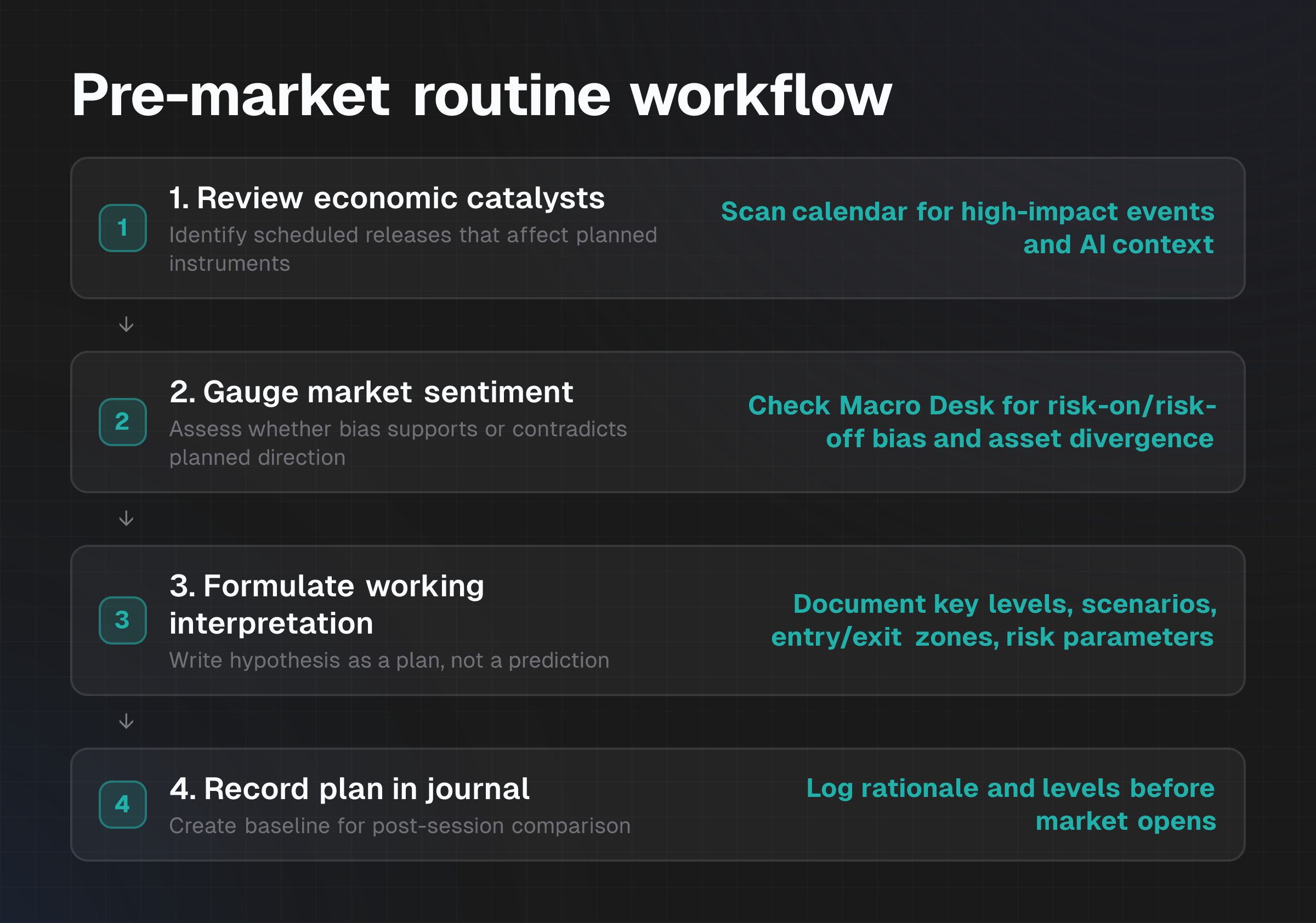
A trader's pre-market routine unfolds in four steps, each supported by the platform.
Step 1: Review the day's economic catalysts
The trader opens HybridTrader's economic calendar and scans for high-impact events scheduled that day. The AI read flags significant announcements and their expected time of release. For example, a central bank interest rate decision might be highlighted as a major catalyst likely to create volatility in currency pairs.
What the trader assesses independently: Whether that event affects their planned trading pairs or instruments, and what direction a given outcome might push prices. The calendar provides the event; the trader interprets its relevance.
What changes: The level of volatility expected, the specific assets to watch, and whether to adjust position size or avoid trading certain instruments around the release.
Step 2: Gauge overall market sentiment and bias
The trader consults the Macro Desk to understand the prevailing market direction. The desk identifies market bias (whether sentiment is generally risk-on or risk-off), shows which assets are performing strongly or weakly, and flags moves that go against the broader bias.
What the trader assesses independently: How that bias aligns with their planned trades, and whether it supports or contradicts their working interpretation. A trader might notice that despite an overall risk-off bias, a specific currency is strengthening, signaling potential divergence they want to trade.
What changes: The preferred direction of trades (favoring longs, shorts, or neutral positions), which assets to prioritize, and whether to adjust their plan based on unexpected market alignment.
Step 3: Formulate a working interpretation and scenario plan
Based on economic events and market bias, the trader develops a preliminary plan. They identify key price levels, support and resistance zones, entry and exit areas, and risk parameters. They also consider "what if" scenarios: what happens if the economic data comes in hotter than expected, or if geopolitical news shifts sentiment overnight.
This is the trader's written hypothesis. Not a prediction, but a documented interpretation of the day's potential, expressed as a plan.
What the trader assesses independently: All of it. The platform provides data and context; the trader decides what matters, which levels to watch, and how to respond to different outcomes.
What changes: The specific setups considered, the level of conviction in each, and the flexibility or rigidity of the plan.
Step 4: Record the pre-market plan for post-session review
The trader documents the pre-market analysis and plan in HybridTrader's journal. This record captures the rationale, the key levels identified, the planned entries and exits, the risk management rules, and the working interpretation, all before the market opens.
Later, during and after the session, the trader records actual trades against this baseline. The journal now contains both the plan and the outcome, creating a paired record for review.
What the trader assesses independently: The accuracy and completeness of the recorded plan. Poor record-keeping, skipping the rationale or omitting key levels, hinders later review.
What changes: The ability to objectively compare the pre-market process against actual performance. Without this record, post-session analysis becomes reactive and subjective.
What the output means
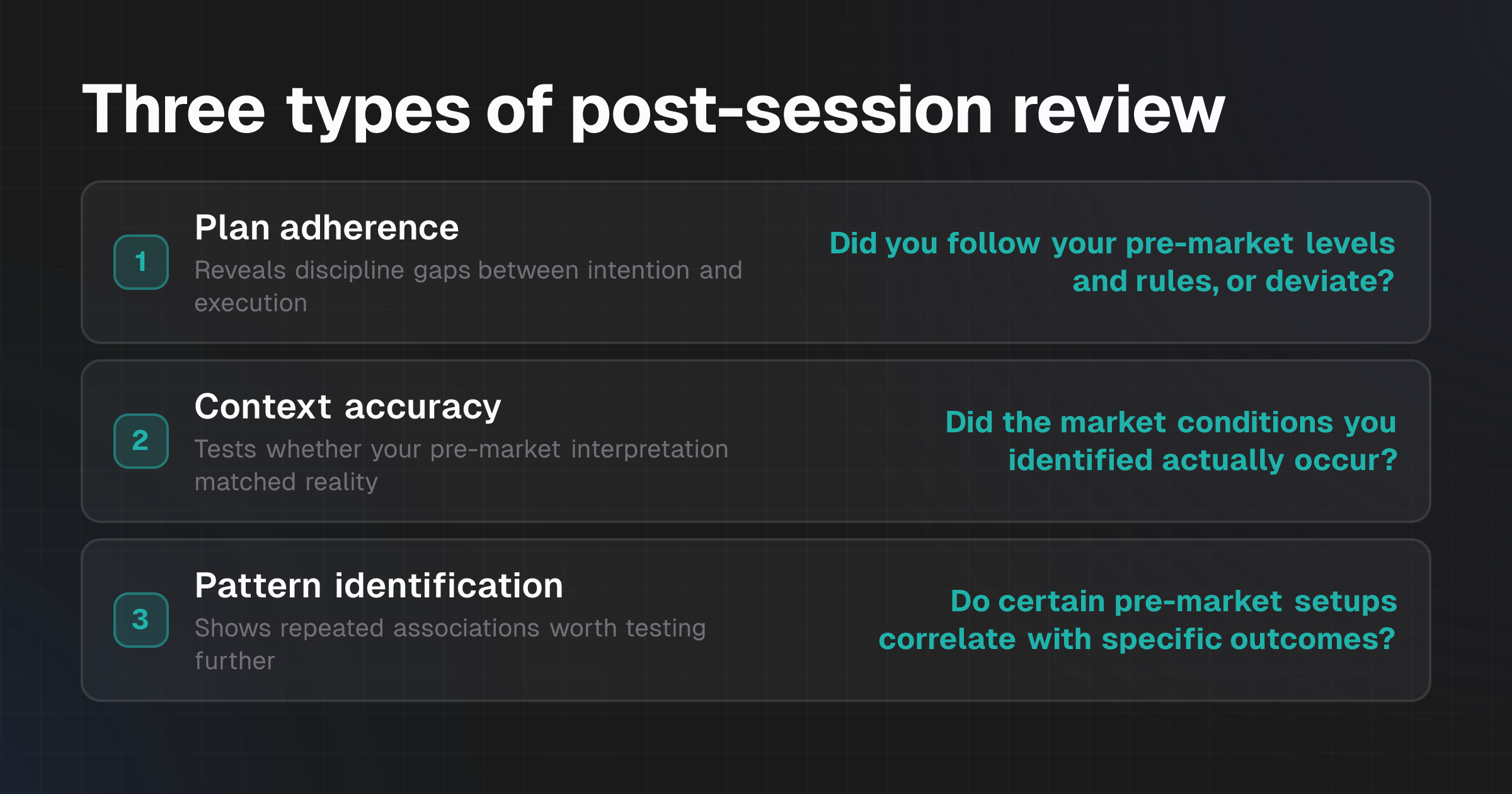
The journal produces a linked record: a documented plan and the trades that followed it. This record supports three types of review:
Plan adherence: Did the trader follow their pre-market levels and rules, or did they deviate? If they deviated, did the deviation improve or harm their session results?
Context accuracy: The trader identified certain market conditions and scenarios as likely. Did those conditions actually occur? If they did, did the market behave as expected?
Pattern identification: Across multiple sessions, did the trader's pre-market interpretation correlate with certain trade outcomes? For example, does a risk-off bias consistently lead to short entries in growth stocks, and if so, what's the win rate on those entries?
A repeated association is evidence worth reviewing, not proof of causation. The journal can show that a pattern appeared in recorded trades; it can't establish with certainty why it occurred.
For instance, a trader might notice that they win more often when they enter on the first volatility spike after an economic release. That observation is worth testing further. But it doesn't prove the spike caused the win. Other factors (position sizing, market direction that day, or even luck) may have contributed.
Similarly, behavioral observations should be checked against the underlying recorded trades. A trader might feel they were disciplined on a given day, but the journal record may reveal that they took three unplanned entries. Documenting the plan first makes this gap visible. For more on reviewing decision quality rather than just outcomes, see How HybridTrader Reviews Decision Quality.
What it cannot prove
The journal and pre-market routine have real limitations.
Individual trade predictability: Market context can support review, but it can't make an individual trade predictable. A trader might have a sound plan and enter exactly on their identified level, yet the market might reverse immediately. A losing trade can follow a sound process, while a winning trade can result from a poor decision. The journal records both; it doesn't guarantee that the sound process will repeat its outcome.
Causation: A trader may notice that they lose money more often on Mondays, or that they win more after high-volatility sessions. The journal documents the pattern. But correlation isn't causation. It's possible that poor emotional discipline on Mondays, market microstructure changes at the week's start, or many other factors are at play. The journal doesn't isolate cause. For deeper context on what a journal can and cannot establish, read Can AI Trading Journals Predict Future Performance.
Forecasting or market movement: Neither the economic calendar, the Macro Desk, nor any AI read forecasts where markets will move next. They provide context and historical impact assessments. But market outcomes depend on millions of participants' decisions, unexpected news, and genuine uncertainty. The journal and routine don't eliminate that uncertainty.
Profitability or win rate improvement: Neither approach guarantees improved profitability or a higher win rate. A trader might implement a perfect pre-market routine and still experience losing periods. A documented plan might increase consistency or reduce emotional bias, but it doesn't promise returns.
Self-awareness without bias: A trader may believe their working interpretation is sound, but the journal can't verify whether it's free from confirmation bias, anchoring, or other cognitive errors. Recording the plan is a step toward objectivity, but it isn't objectivity itself. Over-reliance on AI insights, without maintaining self-awareness over forecasting accuracy, creates risk. The trader must stay in control of entries, exits, and risk.
Privacy, security and user control
This article doesn't cover HybridTrader's specific privacy policies, encryption methods, data retention practices, or user control features. A trader considering the platform should review its privacy and security documentation directly.
Who it may suit
This workflow suits active traders who:
-
Trade systematically and want to maintain a repeatable routine rather than rely on day-to-day intuition.
-
Trade around economic events and want to document their pre-event expectations to review afterward.
-
Want to identify patterns in their trading by comparing recorded plans to outcomes across multiple sessions.
-
Trade multiple asset classes and want a consolidated view of market bias and context.
-
Are disciplined about record-keeping and can maintain consistent journal entries before, during, and after sessions.
-
Recognize that a pre-market routine doesn't guarantee wins, but believe that documented planning and review may improve their process over time.
It may not suit traders who:
-
Scalp short-term intraday moves and can't reasonably document a pre-market plan because their strategy adapts minute-to-minute.
-
Aren't willing to spend time recording trades and plans systematically.
-
Believe that a tool or AI insight can forecast market movement reliably, rather than supporting their own decision-making.
-
Don't review their past trades or sessions, and therefore wouldn't benefit from a documented baseline.
Next step
If this workflow aligns with your approach, start by documenting your pre-market routine manually for two to three sessions. Identify the economic events you care about, assess market bias before the session, and write down your plan and key levels. Then record your trades against that plan.
After the session, compare the two. This low-cost experiment reveals whether the routine itself, before any tool, helps you maintain discipline and generate insight. Once you understand the value of the routine, you can evaluate whether a platform like HybridTrader streamlines the process and enables pattern review across many sessions.
For guidance on structuring a trade journal and reviewing decisions, read Stop Bad Trading Habits: Review Decisions With Real Data. To understand what patterns a journal can and can't show, see How to Find Trading Patterns in Your Journal.