
What an AI Trading Journal Records (and What It Cannot Know)
- HybridTrader Editorial
An AI trading journal automatically captures trade execution data, market context, and behavioral reflection in one place, then uses that combined record to help traders identify patterns in their decision-making and performance. Unlike manual journals, these platforms integrate directly with trading platforms (supporting 50+ integrations in some cases) to sync trade details in real time, enrich trades with macroeconomic data and news events, and prompt traders to record their emotional state and reasoning. The output is pattern analysis designed to surface recurring habits and market conditions, not forecasts or trading signals.
The core value lies in linking what happened in a trade, entry price, exit, profit or loss, to why it happened: the market context at the time and the trader's state of mind. That evidence can support review. It can't prove causation or guarantee better results.
Quick answer: What an AI trading journal records and why
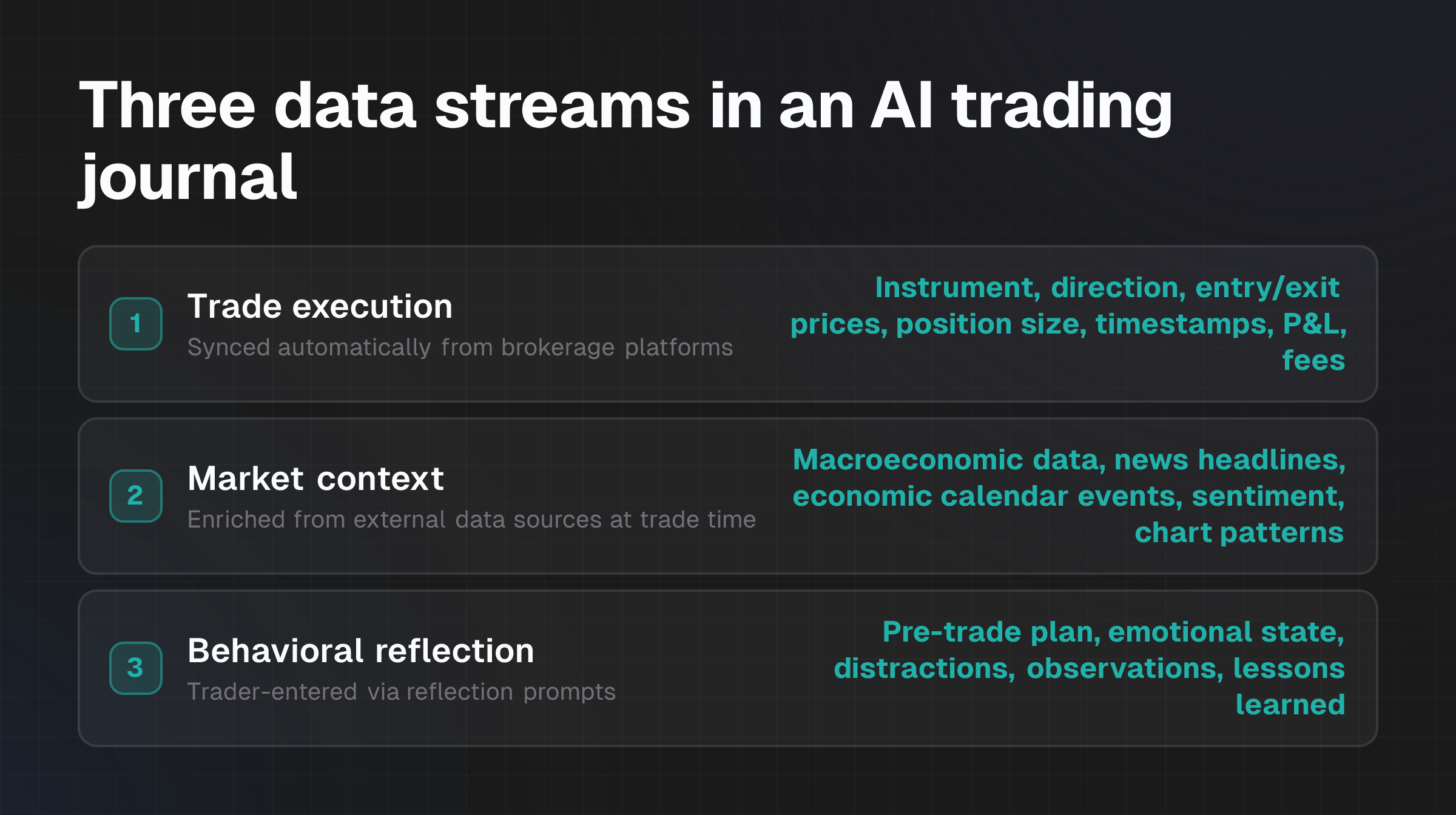
An AI trading journal combines three data streams, trade execution, market context, and trader reflection, into a single record. It automatically syncs trades from brokerage accounts and enriches each one with external market data and AI analysis.
The output is a searchable, contextualized archive designed to reveal patterns in both market behavior and personal decision-making. A repeated association between a market condition or a personal behavior and a trade outcome is evidence worth reviewing, not proof of causation.
The problem it addresses
Manual trading journals require hand entry and time-intensive review.
They capture what happened (entry, exit, profit/loss) but lose the market context needed to understand why. A trader might notice they lost money on five GBP/USD trades but lack easy access to the interest rate environment, news headlines, or economic calendar events that coincided with each one. Over time, patterns become buried in spreadsheets or notebook entries.
An AI journal removes the data-entry friction by syncing directly to live trading accounts and automatically collecting market context. The stated intent is to reduce the overhead of pattern review, making it possible to surface recurring themes, both in market conditions and in personal behavior, that manual review might miss or take too long to identify.
What the feature does
An AI trading journal performs three primary functions:
- Automated trade capture: Connects to brokerage or trading platforms (supporting 50+ integrations in HybridTrader's case) and automatically logs each trade without requiring manual entry. The journal only watches and syncs; it never opens, changes, or closes trades.
- Market context enrichment: Integrates external data sources to attach macroeconomic indicators, news, economic calendar events, and sentiment to each recorded trade, ensuring every decision is seen in context.
- Pattern analysis and feedback: Reviews the combined execution, market, and behavioral data to identify recurring habits, correlations between personal behavior and outcomes, and deviations from planned execution. Some platforms offer structured AI feedback described as reviewing trades against your own history or providing an AI psychologist for discipline and patterns.
Trade execution details
The journal automatically captures fundamental metrics directly from the trading account:
- Instrument (currency pair, stock, commodity, etc.)
- Direction (buy or sell)
- Entry and exit prices
- Quantity or position size
- Entry and exit timestamps
- Trade duration
- Realized profit or loss
- Commissions and fees
Market context data
External data sources are integrated to provide the broader environment at the time of each trade:
- Macroeconomic data: Interest rates, inflation, GDP figures, employment reports, and econometric models reflecting global macro models and analysts expectations.
- News and economic calendar: Significant headlines and scheduled economic events that coincided with trade entry or exit. Some platforms offer the ability to narrow the calendar to currencies and impact levels you trade.
- Price action and technicals: Chart patterns, technical indicators, and price movements for the traded asset and correlated assets. Some platforms offer AI chart analysis on the instruments you trade.
- Sentiment data: Market sentiment or sentiment specific to an asset or sector at the time of the trade.
Behavioral and reflection data
The journal prompts traders to input subjective information about their decision-making and emotional state:
- Pre-trade plan or rationale
- Emotional state during the trade (e.g., confident, anxious, greedy)
- Distractions or external factors
- Observations on how you felt during and after the trade
- Lessons learned or self-reflection
This behavioral input is optional but intended to provide context for the AI's pattern analysis.
Step 1: Data ingestion
Traders connect their brokerage or trading platform account to the journal. For supported platforms, trades sync automatically and in near real-time. For unsupported platforms, traders upload trade data via CSV file.
Most journals provide a guided upload process with automatic column recognition and manual adjustment options, allowing traders to preview trades before saving and handling common date/time formats and various instrument names.
Step 2: Enrichment and categorization
Once ingested, each trade is automatically enriched with market context data. The journal pulls macroeconomic data, news headlines, and economic calendar events that occurred around the trade's entry and exit times. Chart analysis and sentiment data may also be attached.
The trader can then input behavioral data through reflection prompts, recording their reasoning, emotional state, and any observations they wish to associate with the trade.
Step 3: AI analysis
The platform analyzes the combined execution, market, and behavioral data to identify patterns. This analysis includes:
- Identifying recurring habits or tendencies in trade selection, sizing, or execution
- Linking trade outcomes to market conditions and personal behaviors
- Comparing actual execution to pre-defined plans or historical performance
- Flagging anomalies or deviations from profitable patterns
- Quantifying the cost of identified bad habits in dollar terms
The AI reads the psychology behind your trades by correlating behavioral inputs and inferred patterns with trade outcomes. Feedback is delivered as structured summaries showing why each trade worked, or didn't and what your habits cost, and which one to fix first.
Step 4: Review and iteration
Traders review the AI's pattern analysis and feedback against the underlying trade records.
The journal is designed to support reflection and decision-making review, not to execute trades or provide trade signals.
What the output means
An AI journal produces two types of output: contextualized trade records and pattern summaries.
Contextualized trade records show each trade alongside the market environment at the time, the macroeconomic data, news, and economic calendar events that coincided with entry and exit. This context allows a trader to review a loss (for example) while also seeing the interest rate decision or employment report that moved prices during the trade window. A losing trade can follow a sound process, while a winning trade can result from a poor decision; context helps distinguish between the two.
Pattern summaries aggregate observations across multiple trades. An AI journal might surface observations like:
- "You entered this instrument in 80% of your trades when the central bank was signaling policy tightness."
- "Trades entered after you noted high stress in your reflection had a 35% win rate; trades entered when you noted discipline had a 62% win rate."
- "These five trades cost you $450 combined; they all shared a common setup violation versus your pre-trade plan."
These summaries are presented as observed associations in the recorded data. They're evidence worth reviewing, not proof of causation. A repeated pattern is a signal to investigate further, not a confirmed rule.
Correlation is not causation
The journal can show that a pattern appeared in recorded trades; it can't establish with certainty why it occurred.
A trader might notice that three losing trades all coincided with a scheduled central bank announcement. The AI can flag that association. But it can't prove that the announcement caused the loss, nor can it predict whether the next trade on an announcement day will also lose. Market conditions are complex, and a single variable (like an economic calendar event) rarely determines an outcome in isolation.
Limited scope of "psychological reading"
The AI's ability to read the psychology is based on observed patterns in recorded data and input from reflection prompts, not genuine human understanding. The AI reads the trader, not just the trade, but this is an analytical reading of correlations, not a cognitive one.
A pattern in behavioral input (e.g., "stressed" trades underperforming) is an observed association, not a diagnosis of why stress led to worse decisions.
No guarantee of improved results
The presence of a pattern, even a strong one, doesn't guarantee that awareness of it will change outcomes. A trader might recognize that they consistently over-size after winning trades, but changing that behavior requires discipline and consistency. Neither approach guarantees improved profitability or a higher win rate.
The tool's value depends on the trader's willingness to act on the insights and maintain consistent execution.
Data quality dependency
The quality of AI analysis depends entirely on the accuracy and completeness of ingested data and behavioral input.
If trades are incorrectly imported, market context data is sparse, or behavioral prompts aren't filled in, the pattern analysis will be correspondingly limited.
Unspecified algorithms
The exact AI algorithms, thresholds, or models used for pattern identification and behavioral analysis are proprietary and not publicly detailed. The journal's stated functions can be observed, but the underlying methodology for quantifying a bad habit or pricing every bad habit to the dollar remains opaque.
Privacy, security and user control
Sharing trade data and behavioral reflections with a third-party AI platform introduces data privacy considerations. Traders should review the platform's data handling policies, encryption practices, and terms of use before connecting live trading accounts.
Most modern platforms offer account-level read-only connections, meaning the journal can view trades but can't execute them. However, traders should confirm this before connecting.
Behavioral data, emotional state, personal observations, and strategy details, may constitute proprietary or sensitive information. Traders should understand how long this data is retained, whether it's used to train AI models, and whether it's shared with third parties. The platform should offer controls over data retention and deletion.
An AI journal is intended to provide you with a reference only, rather than as a basis for making trading decisions. It offers research and educational insights, not trade execution or financial advice. Traders remain responsible for all trading decisions.
Who it may suit
An AI trading journal is most useful for traders who:
- Maintain a consistent volume of trades (at least several per week or month) and want to surface patterns that manual review would require hours to identify.
- Are willing to invest time in recording behavioral reflection, emotional state, reasoning, distractions, because the journal's pattern analysis depends on this input.
- Trade multiple instruments or time frames and want market context automatically attached to each trade to reduce manual research.
- Already use a brokerage platform that's directly supported by the journal, allowing automatic syncing instead of manual CSV uploads.
- Are interested in self-awareness and decision-review as a learning tool, rather than seeking guaranteed performance improvement or a mechanical trading signal.
- Trade in a regulatory environment where account-level API connections to third-party tools are permitted.
A trader using a single, lightly-traded position or who prefers to manage their journal without external tools may not derive enough value to justify the overhead of connecting an additional platform.
Next step
To evaluate whether an AI trading journal fits your workflow, confirm three details: whether your brokerage is among the 50+ supported platforms, whether you're willing to input behavioral reflection data consistently, and whether your account permissions allow read-only API connections to third-party tools. Review the platform's data privacy and retention policies before connecting a live account. Start with a small sample of historical trades to assess whether the enriched context and pattern output align with your review process and learning goals.