
Forex Trading Journal: Day-to-Day Setup
- HybridTrader Editorial

A forex-specific trading journal must capture variables unique to currency markets: the spread paid at execution, overnight financing costs (carry), the time-zone session in which the decision was made, and the impact of weekly rollovers on position costs. Recording these alongside standard trade data, entry price, exit price, position size, profit/loss, creates a foundation for later pattern review. Without systematic logging of these currency-market details, traders cannot assess whether their decisions aligned with their trade plans or identify recurring behavioral patterns tied to specific market conditions.
This article explains how to structure a forex journal to document trades around scheduled economic events and market sessions, then review them to refine future decisions. It's written for traders who want to understand what variables matter in currency trading and how to record them consistently for analysis, not for predicting market direction.
Quick answer: Building a Forex-Specific Journal Structure
A forex trading journal differs from equities or futures journaling because it must capture spread costs, carry (overnight interest differentials), time-zone decision windows, and weekly rollover impacts. These variables are specific to currency pairs. They directly affect the true cost and timing of each trade. A structured journal that logs these elements, alongside standard entry/exit prices, position size, and stop/profit levels, enables traders to analyze patterns in their decision-making and execution quality across different market conditions and sessions.
What the event measures: Currency-Market Variables in Trade Context
A forex journal doesn't measure a single market event. Instead, it records the trader's decisions and market conditions surrounding each trade. The key variables it must capture are:
Spread at Entry and Exit: The difference between bid and ask price at the moment of trade execution. Spreads widen during volatile periods or less liquid hours, directly increasing execution cost. Recording the actual spread taken, not an assumed average, shows whether trades were executed during optimal liquidity conditions.
Carry (Interest Paid or Received): The overnight financing cost or credit for holding a position. For trades held multiple days, the interest rate differential between the two currencies in the pair either reduces or increases net profit. Weekly rollovers, adjustments made when trades roll from Wednesday to Thursday to account for the weekend, often apply three times the usual daily interest. Logging the carry amount and any weekly rollover flag captures the true holding cost.
Time-Zone Context: Which major market session (London Open, New York Close, Tokyo session, for example) the trade decision was made and executed within. Different sessions attract different market participants and liquidity profiles, which can influence price movement and execution quality.
Currency-Specific Economic Data: Relevant economic releases such as GDP, CPI, or interest rate decisions pertaining to the currencies in the pair, recorded alongside actual versus forecasted values. Sources such as Eurostat provide high-quality statistics covering key European indicators, while the Bank of England publishes monetary policy decisions and financial stability information.
Central Bank Commentary or Actions: Statements, speeches, or policy decisions from the relevant central banks (European Central Bank for EUR, Bank of England for GBP) that may have influenced the trade environment.
These variables are distinct from general market journalism. They're operational metrics specific to how currency pairs behave and trade.
Why traders monitor it: Recording Context for Later Pattern Review
Traders monitor and record these variables not to predict the next market move, but to establish a factual record of the conditions under which they made decisions.
Execution Quality Assessment: By logging spread at entry and exit, a trader can later review whether executions occurred during favorable liquidity or whether trades were entered during widened-spread periods (which may coincide with news events or low-activity hours). Over time, patterns may emerge, for example, consistent execution in high-spread windows, which increases true trade cost.
Carry Impact on Longer Positions: Traders holding positions across multiple days accumulate carry costs or credits. Recording these highlights whether interest-rate differentials systematically helped or hindered profitability, and whether weekly rollovers created unexpected cost spikes. This is critical for swing traders or position traders who hold overnight.
Time-Zone Decision Patterns: Logging the session in which trades were entered allows later review of whether certain times of day correlate with better or worse trade outcomes. A trader may discover they make systematically different decisions during the New York session versus the Tokyo session, or that their trade plans work better in high-liquidity windows.
Economic Event Context: Recording which economic releases were pending or had just occurred provides context for understanding whether a trade was made in reaction to news, in advance of data, or during a quiet period. This supports later review of whether the trader's news-trading approach was consistent or reactive.
Behavioral Pattern Identification: Emotional states and psychological factors logged before, during, and after trades can be checked against recorded outcomes. A trader may later discover they take larger risks after losses, or that decisions made during certain time zones tend to be more impulsive. Behavioral observations should be checked against the underlying recorded trades to separate perception from fact.
The journal becomes a tool for self-assessment and process refinement, not a market forecasting instrument.
Possible scenarios, not predictions: How to Record Trade Context Without Assuming Outcomes
When documenting a trade around scheduled economic data or time-zone sessions, record what was knowable before the trade and what became evident after. Don't backfill journal entries with hindsight.
Before Trade Entry:
- Note the scheduled economic release, if any (e.g., "US CPI release at 13:30 UTC"). Record the consensus forecast and the previous actual reading, if available. This establishes what market participants were expecting.
- Log the current time-zone session (e.g., "New York session open").
- Record the pre-entry spread, bid-ask prices, and recent volatility context observed.
- Note your trade plan: the technical or fundamental rationale for entry, the stop-loss and take-profit levels, and the position size.
- Record your emotional or psychological state if relevant (e.g., "calm," "rushed," "revenge trading after loss").
During the Trade:
- If the trade is held through a scheduled event (e.g., a central bank decision or economic release), record the time of the event and note whether you kept the position open or closed it pre-event.
- If an unexpected market move occurs, record the approximate time and the market action observed, not your interpretation of its cause.
After Trade Exit:
- Record the actual exit price, the spread at exit, and the profit or loss in both currency units and pips.
- Document any carry applied (daily or weekly rollover, if applicable).
- Note whether the trade outcome aligned with the plan (e.g., "hit take-profit as planned," "stopped out before economic release," "held through event, closed at support level").
- Record lessons learned, including whether the process was sound (regardless of outcome) and what could be changed next time.
An example entry might read: "Long EUR/USD, entered 1.0850, 1.2 pip spread, New York open, before ECB statement scheduled 13:45 UTC. Plan: technical break above resistance. Closed 1.0865, 1.3 pip spread at exit, +15 pips. Held through event, no adverse move. Carry credit: +0.30 USD. Outcome: trade plan executed correctly, exited at target."
This approach records observable facts and separates the trade execution from market context without assuming or inventing causal links.
Markets commonly affected: Currency Pairs and Time-Zone Sessions in Focus
Forex trading involves all currency pair combinations, but a journal structure should emphasize pairs and sessions most relevant to the trader's strategy.
Major Currency Pairs: EUR/USD, GBP/USD, USD/JPY, and USD/CHF are typically the most liquid. Spreads tend to be tightest during the overlapping London and New York sessions (approximately 12:00-17:00 UTC). Trades in these pairs and sessions often have lower execution costs.
Emerging-Market Pairs: Pairs such as USD/MXN or USD/BRL typically have wider spreads and may see larger carry differentials (interest-rate gaps between the two currencies). Recording spread and carry is especially important for these pairs, as execution cost and financing cost can materially affect profitability.
Time-Zone Sessions: The Tokyo session (roughly 22:00-07:00 UTC), London session (07:00-16:00 UTC), and New York session (12:00-21:00 UTC) each have distinct liquidity and participant profiles. A trader should note which session a trade was made in, as this affects both spread and typical volatility patterns.
Weekly Rollover Days: Wednesday-to-Thursday rollover is the key date to flag in the journal, as spot forex positions held overnight from Wednesday to Thursday incur triple the usual daily interest adjustment. Any trade held across this boundary should be marked with a "weekly rollover flag" and the carry amount recorded.
What to record in a journal: Essential Fields and Forex-Specific Variables
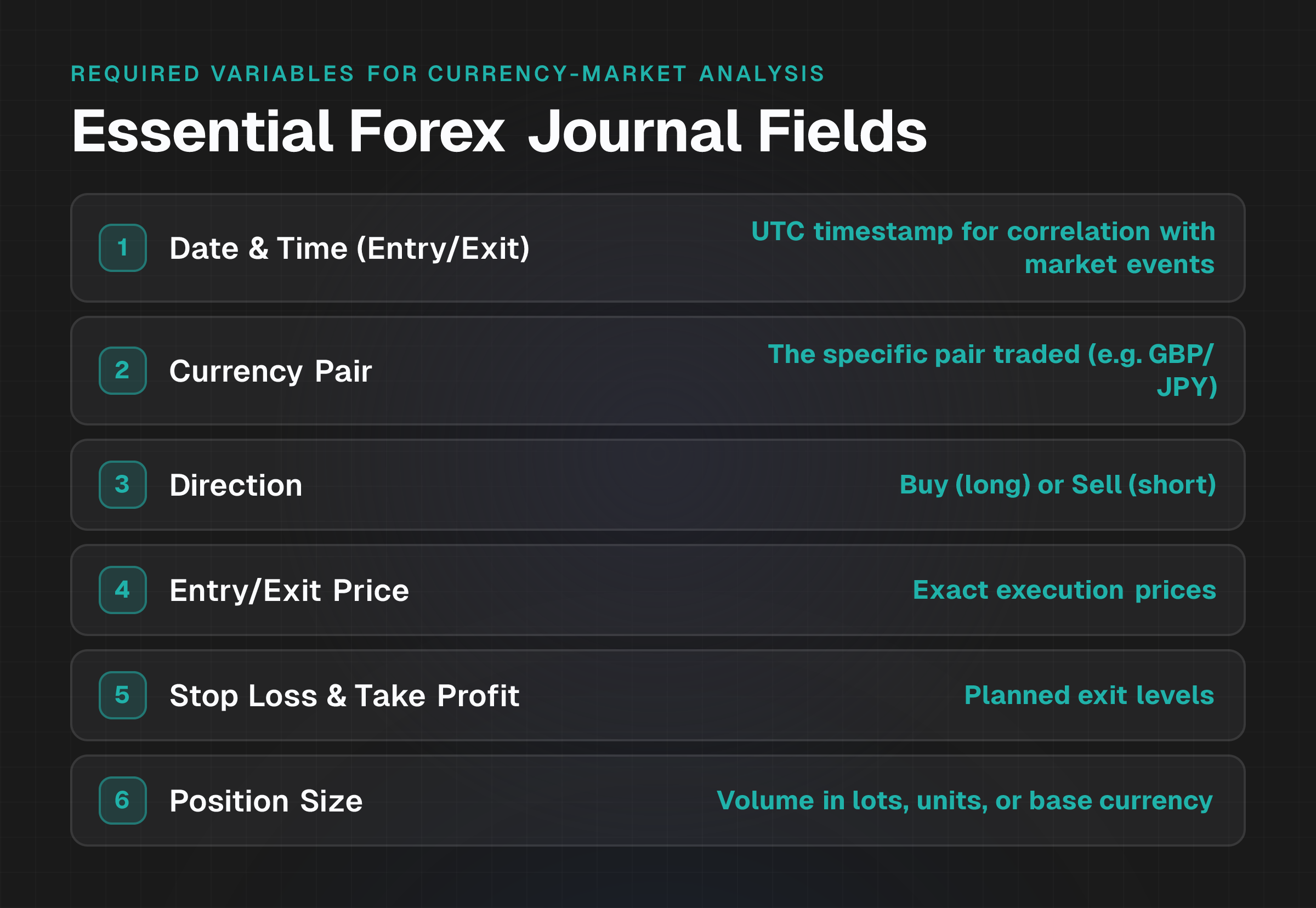
A forex trading journal should include standard trade fields and supplementary currency-market context.
Core Trade Data
- Date and Time (Entry & Exit): Essential for correlating with market events and time-zone analysis. Use UTC or a consistent time zone.
- Currency Pair: The specific pair traded (e.g., GBP/JPY).
- Direction: Buy (long) or Sell (short).
- Entry Price and Exit Price: Exact prices at which the trade was opened and closed.
- Stop Loss and Take Profit: The price levels at which the trade would be automatically closed or manually exited.
- Position Size: The volume traded, recorded in lots, units, or base currency amount.
- Profit/Loss: The actual outcome in currency units and in pips.
Forex-Specific Variables
- Spread at Entry and Exit: The bid-ask spread at execution and exit. Record the actual spread taken, not an estimated average.
- Carry (Interest Paid or Received): For overnight positions, note the daily carry credit or debit. For trades held across Wednesday-to-Thursday, flag the weekly rollover and record the triple-interest adjustment applied.
- Time-Zone Context: The major market session in which the trade was made (e.g., "London Open," "New York Close").
- Weekly Rollover Flag: For trades held over Wednesday into Thursday, mark whether rollover occurred and its cost or credit.
- Currency-Specific Economic Data: Relevant economic releases (e.g., GDP, CPI, interest rate decisions) pertaining to the currencies in the pair, recorded alongside actual versus forecasted values.
- Central Bank Commentary/Actions: Any statements, speeches, or policy decisions from relevant central banks that influenced market conditions.
Pre-Trade and Post-Trade Analysis
- Trade Plan: The rationale for entering, technical analysis, fundamental analysis, or carry strategy, plus risk management considerations.
- Market Context: Broader sentiment or significant events at the time of entry.
- Emotional State: Personal feelings or psychological factors before, during, and after the trade (e.g., "calm," "impatient," "recovering from a loss").
- Lessons Learned: Observations about what went well, what could improve, and whether the market behaved as expected.
The useful question is not which tool sounds most advanced, but which workflow a trader can maintain consistently. A simpler journal kept daily will yield more actionable data than a comprehensive system abandoned after a few weeks.
How to review the session afterwards: Implementing a Review Cycle
A systematic review cycle converts raw journal entries into actionable insights.
Daily Review
Spend 10-15 minutes after market close reviewing the day's trades. Check:
- Whether each trade followed the plan or deviated.
- Whether execution occurred at reasonable spreads or during unfavorable liquidity.
- Whether any emotional factors affected decision-making (e.g., revenge trading, overconfidence after a win).
- Whether carry or rollover flags affected profitability unexpectedly.
Record immediate observations and any adjustments to the next day's approach.
Weekly Review
Allocate 30-45 minutes to analyze patterns across multiple trades:
- Compare trade outcomes against trade plans. How many trades hit their take-profit target? How many were stopped out? How many were closed manually?
- Identify recurring patterns in entry or exit strategies (e.g., "all losing trades were entered during the first 30 minutes of New York open," or "winning trades consistently rode the move for more than 2 hours").
- Analyze spread and carry data: Did trades in certain pairs or sessions consistently incur higher execution costs?
- Review emotional or behavioral notes: Do certain time zones or market conditions correlate with more impulsive decisions?
Weekly review is where pattern identification begins. The journal can show that a pattern appeared in recorded trades; it cannot establish with certainty why it occurred. A repeated association is evidence worth reviewing, not proof of causation.
Monthly and Quarterly Review
Conduct deeper analysis by aggregating weekly findings:
- Calculate overall profitability by pair, session, and strategy type.
- Review whether adjustments made after weekly reviews improved outcomes.
- Identify larger behavioral trends (e.g., risk-taking increases after losses).
- Assess whether the journal is being maintained consistently and whether recorded fields are yielding useful insights or could be streamlined.
A losing trade can follow a sound process, while a winning trade can result from a poor decision. The journal should be evaluated on consistency of process, not solely on profit and loss. Focusing only on P&L can obscure valuable lessons from sound decisions that lost money or poor decisions that won money.
Verified Data Sources
Economic Data: Eurostat publishes high-quality statistics on European economic indicators. The Bank of England provides details on UK monetary policy decisions and financial stability objectives. Most economic releases carry preliminary, revised, or delayed data statuses; always note the data release type in your journal.
Central Bank Actions: Official announcements from central banks (ECB, Bank of England, Federal Reserve) are the primary source for policy decisions and rates. These are typically published at scheduled times and carry no uncertainty regarding what was announced, though market interpretation may vary.
Spread and Carry Data: These come from your broker's execution platform. Spread varies by broker, market condition, and time of day. Carry rates are set by brokers and vary based on overnight interest rate differentials; brokers publish their carry rates publicly, often in a fee schedule or platform settings.
Time-Zone and Session Data: Defined by currency market conventions (e.g., London Open at 08:00 GMT, New York Open at 13:30 EST). These are objective and recorded at the time of trade execution.
Uncertainties and Gaps
Standardization of Qualitative Variables: While economic data and central bank actions are clear-cut, other currency-specific variables, such as geopolitical risk or idiosyncratic market sentiment, may require subjective recording. A clear, consistent framework for logging these qualitative factors across different trading sessions remains challenging. A trader must develop personal consistency rather than rely on a universal standard.
Optimal Review Frequency: General guidance on daily, weekly, and monthly reviews exists, but the optimal frequency and depth for different trading styles (scalping versus swing trading, or fundamental versus technical strategies) isn't definitively established. Individual traders may need to experiment to find what works for their strategy and schedule.
Causation Versus Correlation: The journal reveals associations (e.g., "I lose money consistently in the Tokyo session") but can't prove causation (e.g., "the Tokyo session causes my losses"). Separating market conditions from personal decision quality requires deliberate analysis and behavioral honesty.
Automated Trading Integration: If a trader uses partially or fully automated strategies, the journal must adapt to capture automated decision-making alongside manual oversight. How best to integrate systematic trading into a traditional journal remains an open question.
Next step: Building Your First Entries and Establishing a Review Rhythm
Begin by logging the next 5-10 trades with all core data fields: date/time, pair, direction, entry/exit prices, stop/profit levels, position size, profit/loss, and spread at entry/exit. Add your trade plan (the reason you entered) and your emotional state at the time.
After these initial trades, conduct a weekly review: note which trades followed your plan and which deviated. Identify whether spreads or session timing created patterns. This first cycle will reveal which journal fields are most useful for your strategy and which feel redundant.
Then expand incrementally. If you trade pairs with significant interest-rate differentials (e.g., emerging-market currencies), add carry tracking. If you frequently hold positions overnight, flag weekly rollovers. If your trades cluster in certain time zones, make session context a priority. The useful question is not which tool sounds most advanced, but which workflow you can maintain consistently.
How to Journal Trades Around High-Impact Economic Events provides a detailed framework for recording decisions during scheduled data releases. Stop Bad Trading Habits: Review Decisions With Real Data covers behavioral review techniques. How to Find Trading Patterns in Your Journal explains how to extract actionable patterns from accumulated entries.
Consistency matters more than perfection. A journal maintained daily with accurate core data and one or two forex-specific fields (spread and carry, or session context) will outperform an abandoned system designed to capture every possible variable. Start small, review weekly, and refine your fields based on what you discover.